
Oxford Robotics Institute | Robots




Legged Robot Systems in Action
Since July 2025, our research team has been actively working on legged robotics across three complementary tracks. The video highlights our 3D-printed bipedal robot for walking dynamics, the Hardware Geek subsystem for robust embedded and actuator integration, and a quadruped inspection system that autonomously navigates industrial environments for anomaly detection. Together, these segments demonstrate our integrated approach from rapid prototyping to field testing, driven by collaborative problem-solving.

From Sensing to Learning
Since July 2025, our research team has been actively exploring intelligent robotics through three complementary technical pillars. This video showcases our work on LiDAR-based 3D reconstruction for environmental mapping, simulation-based training to reduce real-world costs, and reinforcement learning for adaptive control in complex tasks. Together, these segments demonstrate our comprehensive approach from perception and virtual training to intelligent decision-making, grounded in collaborative experimentation.

Document & Medical Vision
Our research team at the Deep Learning and Vision Understanding Group has long been dedicated to advancing visual intelligence across diverse domains. This video presents our ongoing work in Document Image Analysis—covering OCR, layout parsing, and structured extraction from scanned documents—and Medical Image Processing, where we apply deep learning for segmentation, classification, and anomaly detection in CT, MRI, and X‑ray images to support clinical diagnosis, reflecting our sustained commitment to bridging fundamental research with practical applications through years of collaborative refinement.
Visual Semantic Fusion
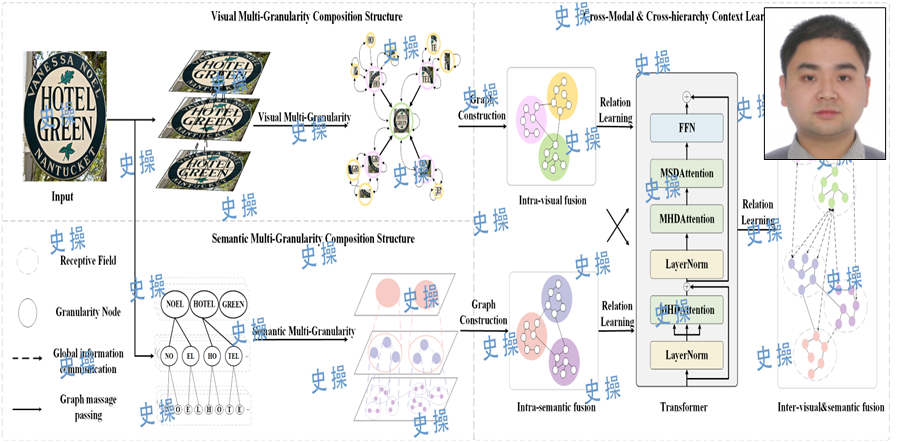
Since November 2023, research has been conducted on scene text detection and recognition methods based on a multimodal framework. To address the issue that current multimodal approaches typically use a single-granularity feature fusion strategy, which fails to fully leverage prior contextual information, a Multi-Granularity Visual Semantic Interactive Fusion Network (MGN-Net) has been proposed. This network includes: (1) a Visual Semantic Multi-Granularity Feature Extraction Network (VSMN); and (2) a Multi-Granularity Graph Fusion Learning Network (MGFN).
Intelligent Interactive Video
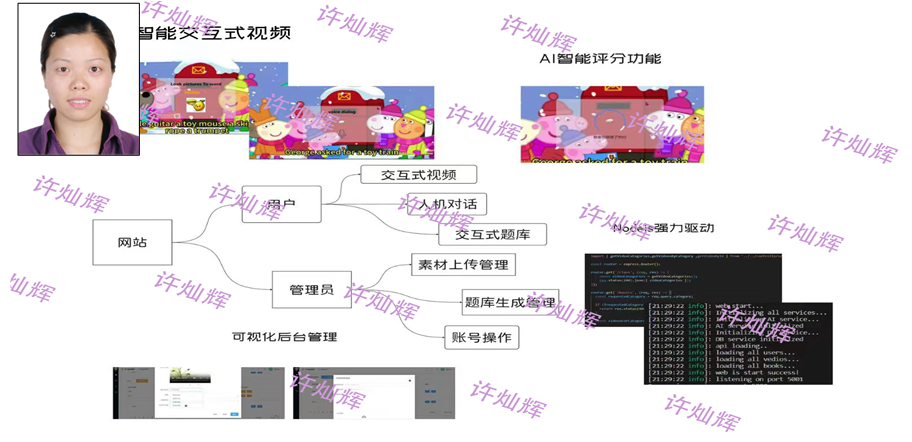
Since February 2024, a team of students has been working on the development of an intelligent English learning website based on AI large models. Leveraging cutting-edge AI technology, the intelligent English learning platform we have developed offers a range of powerful features, including intelligent human-machine dialogue, interactive video learning, as well as automatic question generation and automatic scoring. These features provide learners with an easy and efficient learning experience, helping them effectively improve their English skills.
MGFN for Multimodal Scene Text Spotting
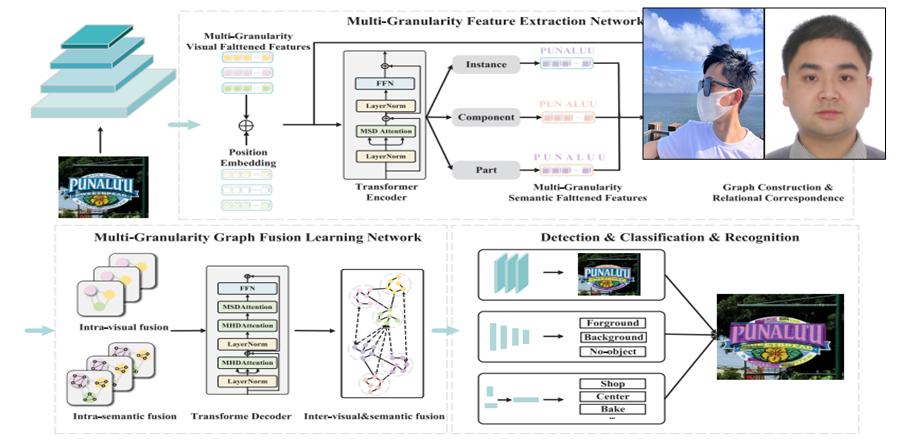
Recent scene text spotting methods have shifted to multimodal frameworks, but most rely on single-granularity feature fusion, failing to fully capture the visual-linguistic context. We propose a novel model, Multi-Granularity Visual Semantic Interactive Fusion Network (MGN-Net), which includes a Visual Semantic Multi-Granularity Feature Extraction Network (VSMN) and a Multi-Granularity Graph Fusion Learning Network (MGFN). The VSMN extracts multi-granularity features to enrich contextual relationships, while the MGFN aligns features across modalities and hierarchies for deep fusion. This approach overcomes the limitations of sequential structures in irregular text. Experiments show MGN-Net outperforms existing models. Code will be released.
International competition
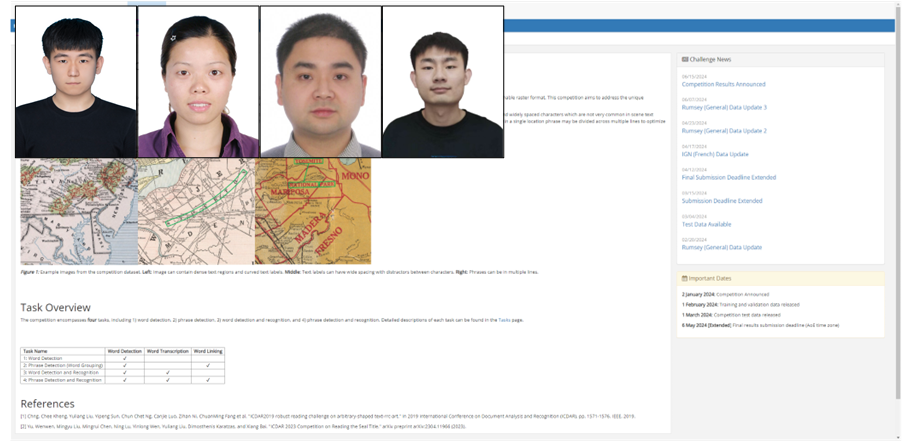
In the individual task at ICDAR 2024, we ranked third. The first place in this task was taken by: Bilibili; The second place was taken by: Tianjin University; The third place was taken by us. In another task, we ranked fifth. The official rankings for this task are: First place: Bilibili Second place: American Express Third place: Tianjin University Fourth place: American Express Fifth place: Ours